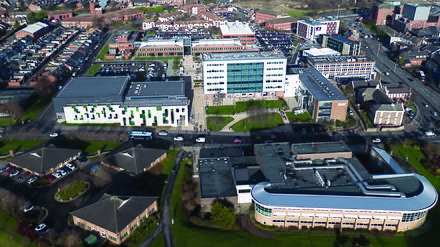
University of Sunderland
About University of Sunderland
The University of Sunderland is a public university located in the North East of England.
Key facts:
-
It has its main campus at Sunderland (Tyne & Wear), and also operates teaching sites/off-campuses (for example London) and online programmes.
-
It emphasises inclusive, global student communities: “Over 40% of our students come from outside of the UK … we welcome students from over 100 countries.”
-
Around 60.5% of its students are ‘home’ fee-status and ~39.5% international fee-status, as per latest student enrolment stats.
-
It offers a broad mix of undergraduate, postgraduate, distance learning, online and blended programmes
Why University of Sunderland?
For international students, here are strong reasons why this might be a good choice:
-
International community & support: More than 100 countries represented; dedicated International Student Support team with visa, welfare, arrival and accommodation assistance.
-
Affordability & living cost: Located in the North East of England (rather than London), meaning typically lower cost of living compared with many UK universities. The university promotes this angle for international students.
-
Flexible study modes: On-campus courses plus online/distance/blended options allow flexibility for international students. E.g., “We have a range of 100 % online degrees and blended learning degrees” for working professionals around the world.
-
Recognised outcomes / student-centric: The university highlights strong teaching quality, subject satisfaction, student support and employability in several metrics.
-
Large range of programmes: For many fields (business, computing, health, creative industries, etc) you’ll find options for undergrad / postgrad / online.
-
International scholarships and reductions: There are tuition-fee discounts aimed at international students.
University ranking
Here’s a breakdown of the ranking picture for the University of Sunderland (as of 2024/25). Important: rankings are one factor, but not the only one to base a decision on.
-
In the Times Higher Education (THE) World University Rankings 2026 the University of Sunderland appears in the 1201+ band (i.e., among 1201-1500) globally.
-
According to the QS World University Rankings Europe 2025, it ranks about 442nd in Europe.
-
According to the university’s own “Our Achievements” page: many subject-areas scored very highly (e.g., Media & Film; Law; Business) within UK subject rankings.
-
The Guardian University Guide 2026 lists it in top 30 UK universities for the first time as of their data.
Interpretation for international students:
While the overall global ranking is modest, Sunderland seems to have strong performance in selected subject areas and student-satisfaction/teaching quality metrics. If your chosen subject is one of its strengths, it could be very good value. Always check subject-specific ranking and graduate outcomes rather than only the overall university position.
Campus Locations
-
The principal campus is in the city of Sunderland, Tyne & Wear, England.
-
There is also a London site (for example for international or global programmes) and online/distance learning delivery.
-
For international students: the “India & South Asia” page shows regional offices and contact points, which is helpful for pre-arrival support.
Types of courses (Study levels)
The University of Sunderland offers a broad set of study levels:
-
Undergraduate degrees (Bachelor’s, honours) across many disciplines.
-
Postgraduate taught programmes (Master’s) and research degrees.
-
Short courses / diploma / foundation / pre-Master’s / online learning. For example: “Over 350 courses including short courses, undergraduate degrees and postgraduate programmes.”
-
Online and distance learning courses and blended modes for international/working students.
Mode of learning (onsite / e-learning / blended)
-
On-campus / face-to-face: Many undergraduate and postgraduate taught programmes are delivered in-person at the main campus.
-
Online / distance learning: There are 100% online degrees designed for working professionals around the world.
-
Blended learning: Some programmes mix online & face-to-face, providing flexibility (e.g., “blended basis with a mix of online and face to face learning in pop up venues” for digital skills).
-
Independent Distance Learning page: allows global learners to study fully remotely.
Number of programmes offered
Here are numbers and indications:
-
The “What types of courses do you offer?” page states: over 350 courses including short courses, undergraduate degrees and postgraduate programmes.
-
The “About the University” statistics page shows student enrolment numbers (not exact programme count) but indicates a large offering.
-
Another summary source: “With over 300 undergraduate and postgraduate degree courses …”
Highlights
-
Recognised for teaching excellence, student satisfaction and subject-specific strength. For example: “We are a top 30 UK university (Guardian University Guide 2026)”.
-
Strong support for international learners: dedicated services for visa, welfare, arrival and life in UK.
-
Flexibility in modes: online, blended, on-campus, good for students who may need remote or part-time study.
-
Good value: combining UK study with relatively lower cost of living (since location is North-East England rather than London), and large scholarship offers for international applicants.
-
Diversity: Over 100 nationalities represented; inclusive community climate.
-
Range of subject areas: from health and wellbeing, business, creative industries, computing & digital, to education, law and more.
-
Career focus: Many programmes co-designed with industry, emphasising employability.
Scholarship
1) Global Leaders Scholarship (2025/26)
-
What: A tuition-fee reduction for eligible international applicants (exclusions apply by region).
-
Amounts: Undergraduate students receive £5,000 off annual tuition (i.e., up to £15,000 across a 3-year degree). Postgraduate students receive £4,500 off course tuition.
-
How awarded: The page says the discount will be applied automatically to eligible applicants; it’s available for a limited time and subject to availability.
2) General international “Overseas” offer / tuition-fee discount
-
The University’s international recruitment pages confirm an ongoing offering of £5,000 tuition fee reduction (UG) / £4,500 (PG) for eligible international students studying on-campus in specified intakes (not applied to preparation or pre-sessional courses). This is prominently promoted to overseas applicants.
3) Other scholarships, bursaries & campus-specific awards
-
Sunderland lists a broad set of bursaries and scholarships: some are automatic if you meet criteria (e.g., academic achievement awards), others require an application (subject-specific awards, hardship funds, the St Nicholas’ Educational Trust awards, etc.). Some awards — like the “Just Add You” bursary — are specifically for home students, so check eligibility carefully.
4) Undergraduate & postgraduate central pages
-
The University publishes separate UG and PG scholarship pages listing which awards are automatic and which need application; these pages are the authoritative starting points for eligibility rules and application steps.
Who is eligible (common rules & important exclusions)
-
Eligible international applicants: The £5,000/£4,500 reductions are targeted at eligible international applicants studying on campus (details and excluded regions are listed on the Global Leaders page — e.g., some regions such as East Asia, Gulf states, Europe may be excluded from a particular round). Always check the specific scholarship terms on the official page for the intake you’re applying to.
-
Home/EU-only awards: Several bursaries and access funds (Fair Access, Just Add You, etc.) are restricted to home (UK) fee status or to UK-resident/EU settled status; those are not available to most overseas international fee-paying students. Read the small print.
-
Automatic vs application: Some awards (e.g., certain fee reductions) are automatic if you meet criteria; others require a formal application and supporting documents (personal statements, evidence of income, audition/portfolio for creative courses, etc.)
Documents you’ll likely need
-
Passport / proof of nationality and residency.
-
Offer letter and course details.
-
Academic transcripts and certificates.
-
English language evidence (IELTS/other) as required.
-
Portfolio/audition material for creative courses (if scholarship assesses talent).
-
Proof of deposit payment (if required to secure a discount).
-
Proof of household income (for means-tested bursaries, where allowed).
Deadlines & timing (practical notes)
-
Many fee reductions and Global Leaders offers are time-limited and may be “subject to availability.” Check the Global Leaders page and the international tuition pages for the exact intake you plan to join. Always accept and pay deposits early if a discount requires it.
-
Scholarships that require application will have specific closing dates posted on the relevant scholarship page; some bursaries for enrolled students are awarded after registration.
Realistic expectations for international applicants
-
Good news: The University of Sunderland offers meaningful tuition reductions for many international applicants (not just token amounts). The £5,000 UG / £4,500 PG reductions are significant and reduce overall cost.
-
Caveat: Several attractive named bursaries and access funds are limited to home/EU fee status students — so do not assume all awards are open to overseas fee-paying students. Always confirm the small print.
Extra funding routes you should consider
-
External scholarships (government & private in your home country).
-
Research studentships if you’re applying for PhD (departmental / DTP funding advertised on PG pages).
-
Part-time work (where visa rules permit) to help living costs.
-
Student loans or sponsor funding from employers/foundations in your country.
-
Contact the International Team — they can confirm whether a specific scholarship will appear on your offer.
Programs
-
GBP 16,000
-
GBP 16,500
-
GBP 16,000
-
GBP 17,400
-
GBP 17,400
-
GBP 17,400
-
GBP 17,400
-
GBP 16,000
-
GBP 16,000
-
GBP 16,000
-
GBP 16,000
-
GBP 16,000
-
GBP 16,000
-
GBP 16,000
-
GBP 16,500
-
GBP 16,000
-
GBP 16,500
-
GBP 16,000
-
GBP 16,500
-
GBP 16,000
-
GBP 16,500
-
GBP 16,500
-
GBP 16,500
-
GBP 14,000
-
GBP 16,500
-
GBP 16,500
-
GBP 16,000
-
GBP 16,500
-
GBP 16,000
-
GBP 16,000
-
GBP 18,335
-
GBP 16,000
-
GBP 16,000
-
GBP 16,000
-
GBP 16,000
-
GBP 16,500
-
GBP 16,000
-
GBP 16,000
-
GBP 16,000
-
GBP 4,500
-
GBP 11,000
-
GBP 16,000
-
GBP 16,500
-
GBP 17,400
-
GBP 16,500
-
GBP 16,500
-
GBP 16,000
-
GBP 16,000
-
GBP 16,500
-
GBP 16,500
-
GBP 11,000
-
GBP 17,750
-
GBP 16,500
-
GBP 16,000
-
GBP 18,000
-
GBP 8,250
-
GBP 14,000
-
GBP 9,000
-
GBP 16,000
-
GBP 16,000
-
GBP 5,500
-
GBP 16,000
-
GBP 16,000
-
GBP 16,000
-
GBP 17,400
-
GBP 16,000
-
GBP 16,000
-
GBP 16,000
-
GBP 16,000
-
GBP 16,000
-
GBP 16,000
-
GBP 16,000
-
GBP 16,000
-
GBP 16,000
-
GBP 8,000
-
GBP 16,000
-
GBP 20,500
-
GBP 17,400
-
GBP 16,500
-
GBP 16,000
-
GBP 16,000
-
GBP 17,400
-
GBP 16,500
-
GBP 16,500
-
GBP 16,000
-
GBP 16,000
-
GBP 16,000
-
GBP 10,000
-
GBP 16,000
-
GBP 16,500
-
GBP 16,000
-
GBP 16,500
-
GBP 16,500
-
GBP 16,500
-
GBP 16,500
-
GBP 16,500
-
GBP 16,500
-
GBP 16,500