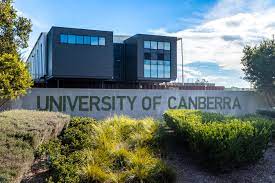
University of Canberra
The University of Canberra (UC) is a public university in Australia’s capital, founded from predecessor institutes and established in its modern form to serve Canberra and the region. UC emphasises work-integrated learning, applied research and close industry links so graduates are job-ready.
Why choose UC (key selling points for internationals)
-
Strong focus on work-integrated learning and industry partnerships (internships, placements and practical projects).
-
Good graduate employability — UC promotes high employment outcomes for graduates in Canberra and Australia’s public service/industry hubs.
-
Compact, green campus in the national capital with direct links to government, research organisations and employers.
University rankings (snapshot)
Rankings fluctuate year-to-year and by table, but UC appears in international ranking lists and subject/impact rankings. (Example: QS/Top Universities lists UC in global rankings; UC also performs well in specific THE Impact categories.) For most accurate, current rank numbers check the UC site and QS/THE pages when you apply.
Campus locations & delivery footprint
-
Main campus: Bruce (Canberra) — this is UC’s primary campus with most student services and facilities.
-
Other delivery: UC delivers programs through partners and campus locations beyond Canberra (including Sydney, parts of Queensland) and international partner arrangements (examples: China, Vietnam, India, Bhutan). Many UC degrees can also be studied online.
Types of courses & study levels
UC offers a full range of study levels:
-
Undergraduate: bachelor degrees, diplomas and certificates.
-
Postgraduate: coursework master’s, graduate certificates/diplomas, professional doctorates.
-
Research: master’s by research and PhD (HDR).
UC’s courses span arts, business & government, design, health, education, science & technology, law and sport/technology areas.
Mode of learning
-
On-campus (face-to-face): Most undergraduate and professional programs.
-
Online / distance learning: Many programs are available fully online.
-
Blended / hybrid: A mix of on-campus and online content is common, especially for postgraduate and professional programs. UC emphasises flexibility for different student needs.
Number of programs
UC publishes that it offers over 200 courses across undergraduate, postgraduate and research levels — this includes majors, specialisations and pathway programs through UC College. Always check the course finder for the exact program code and intake availability.
Highlights & student supports
-
UC markets itself as Canberra’s university with strong employer links (advantage if you want government, policy, research or public sector careers).
-
Student services: orientation for internationals, academic and wellbeing support, careers & placement services, English language pathways (ELICOS/UC College)
Scholarship
Below are the scholarships you’ll see most often when researching UC. Exact names, value and availability can change each intake—always check the UC scholarship page for the specific intake you plan to join.
-
UC International Course Merit Scholarships — merit-based reductions for commencing international students (undergrad & coursework postgraduate) at Bruce or Sydney Hills campuses. Usually requires strong academic results.
-
UC GEMS / Region-based Excellence Scholarships — scholarships targeted at specific regions (e.g., Southeast Asia excellence scholarships) or nationalities. Eligibility and value vary.
-
ELICOS scholarship (UC Colleges / English language) — 15% discount on ELICOS weekly rate when packaged with UC College and/or University of Canberra academic programs (check availability by intake). Sponsored/diplomatic students are usually excluded.
-
Research scholarships & stipends — PhD and some higher degree research candidates can access research scholarships (e.g., RTP scholarships, university-funded stipends). Details and stipend levels are listed on UC postgraduate/research pages.
-
Australia Awards and externally funded scholarships — UC hosts and accepts students funded by government or external scholarships (e.g., Australia Awards) with separate application processes managed by the sponsor.
Typical eligibility criteria (what UC looks for)
-
Academic performance: Most merit scholarships require strong prior results (high school percentages for undergrad, GPA for postgrad). Specific thresholds differ by scholarship.
-
Intake & campus: Some scholarships are for specific campuses (Bruce vs Sydney Hills) or intakes — check the scholarship detail.
-
Course level: Scholarships may be restricted to undergraduate, postgraduate coursework, or research students.
-
Nationality / region: Several awards target students from particular countries or regions (e.g., Southeast Asia).
-
English requirements: If you require ELICOS, discounts may be available (see ELICOS scholarship); many course scholarships still require you to meet UC’s entry English standards.
Documents you’ll usually need
-
Certified academic transcripts (translated to English if needed)
-
English language test results (IELTS, TOEFL) or ELICOS enrolment proof
-
Passport ID page
-
CV / resume and any required statement of purpose or portfolio (for some scholarships)
-
Referees (for research scholarships)
Deadlines & practical tips
-
Deadlines vary by scholarship and intake — some scholarships are “always open” and others have specific cutoffs each year. Apply early for best chance.
-
Apply for admission first — because UC performs automatic eligibility checks, your finished admission application is your gateway to many scholarships.
-
Prepare strong academic evidence: scholarships are often merit-based — include grade certificates, transcripts, and any awards or research outputs.
-
Write a clear supporting statement where permitted — explain why you deserve the scholarship and how your studies at UC will support your goals.
-
Keep copies of everything certified — UC and visa authorities require certified documents.
What scholarships usually cover
-
Tuition fee discounts (partial reductions) are the most common.
-
ELICOS fee discounts (e.g., 15%) for packaged English courses.
-
Research scholarships may include a living stipend and tuition coverage (specific to the scholarship).
-
Fully funded packages advertised on third-party sites sometimes overstate benefits—always verify full details on UC’s official scholarship pages.
Programs
-
AUD 37,900
-
AUD 33,800
-
AUD 33,800
-
AUD 33,800
-
AUD 32,200
-
AUD 37,900
-
AUD 37,900
-
AUD 37,900
-
AUD 34,800
-
AUD 37,900
-
AUD 37,900
-
AUD 36,400
-
AUD 36,400
-
AUD 36,400
-
GBP 36,400
-
AUD 40,000
-
AUD 39,700
-
AUD 33,80
-
AUD 36,100
-
AUD 36,100
-
AUD 34,800
-
AUD 33,900
-
AUD 36,900
-
AUD 32,200
-
AUD 39,000
-
AUD 36,100
-
AUD 36,100
-
AUD 40,200
-
AUD 40,200
-
AUD 42,600
-
AUD 32,200
-
AUD 38,000
-
AUD 38,000
-
AUD 36,100
-
AUD 32,200
-
AUD 34,800
-
AUD 36,100
-
AUD 40,200
-
GBP 15,250
-
AUD 13,850
-
AUD 19,650
-
AUD 18,600
-
AUD 15,750
-
AUD 4,112.50
-
AUD 39,300
-
AUD 30,500
-
AUD 37,200
-
AUD 4,112.50
-
AUD 34,600
-
AUD 28,200
-
AUD 98,700
-
AUD 78,600
-
AUD 4,062.50
-
AUD 78,600
-
AUD 91,000
-
AUD 61,000
-
AUD 74,400
-
AUD 78,600
-
AUD 34,100
-
AUD 64,400
-
AUD 78,600
-
AUD 32,600
-
AUD 79,800
-
AUD 79,800
-
AUD 67,200
-
AUD 79,800
-
AUD 136,500
-
AUD 91,000
-
AUD 95,200
-
AUD 87,800
-
AUD 87,800
-
AUD 104,400
-
AUD 64,400
-
AUD 79,800
-
AUD 53,850
-
AUD 71,800
-
AUD 42,300
-
AUD 64,400
-
AUD 95,200